What if I told you the most powerful leadership and resiliency lessons I’ve ever learned didn’t come from Harvard or Silicon Valley but from being choked on a mat in silence?
… Technique over brute force. Leverage over aggression. Strategy over emotion…
If you’ve spoken to me for more than five minutes, you probably know what I take the most pride in: my family… and my black belt in Brazilian Jiu-Jitsu!
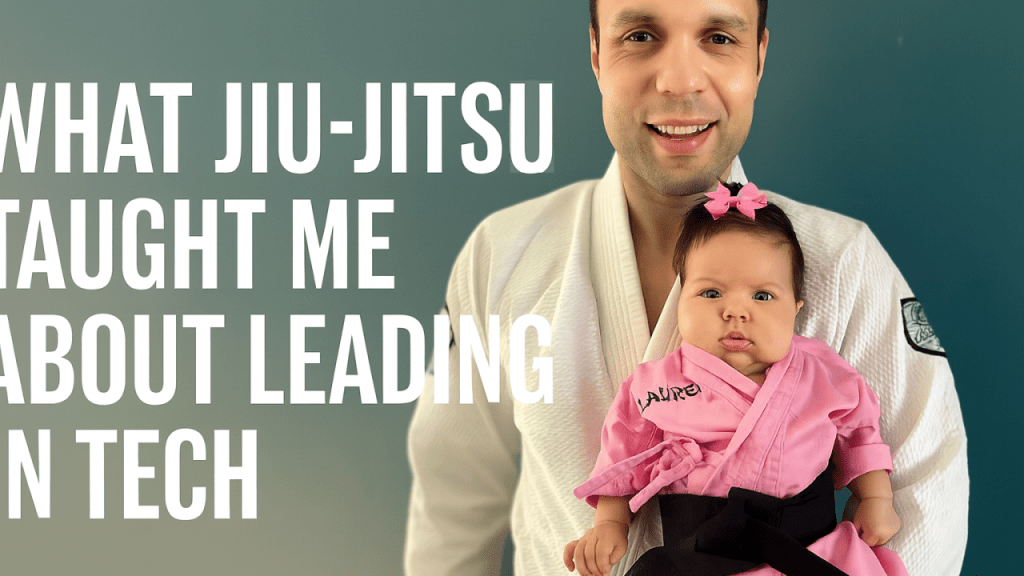
Jiu-jitsu has taught me how to fall and get back up. How to lose with dignity. How to win without arrogance. How to be present under pressure. How to stay calm when the world is on fire. It taught me humility, resilience, and the quiet kind of strength; the kind you build over years, not through promotions or degrees, but through repetition, discipline, and pain.
Mark Zuckerberg trains Jiu-Jitsu. Elon Musk has sparred in it too. But this isn’t just some billionaire hobby. It is a strategy, a mindset, and physics to tackle bigger challenges with less energy that works for everyone. The story of Jiu-Jitsu? It’s one of the greatest entrepreneurial stories ever told.
Jiu-Jitsu didn’t start in big arenas or ESPN pay-per-view specials. It began in Japan, with a man named Jigoro Kano, who developed Judo from traditional Japanese jiu-jitsu. One of his students, Mitsuyo Maeda, took the art to Brazil in the early 1900s.
In Brazil, a young and sickly boy named Helio Gracie couldn’t execute traditional Judo due to his frail physique. So he adapted it. He slowed it down. He used leverage instead of strength. He created a system where the smaller, weaker person could defeat the stronger one; if they understood the mechanics and leverage. That system became Brazilian Jiu-Jitsu.
Then came Rorion Gracie, who brought it to a garage in Torrance, California. The Gracie family issued open challenges. Anyone. Any style. Any size. And they proved time after time that Jiu-Jitsu was different. Not just a martial art, but a strategy. A mindset.
To showcase its effectiveness, the family created the UFC. The very first Ultimate Fighting Championship in 1993 wasn’t about entertainment. It was an experiment. A question: Which martial art really works when it matters most?
Royce Gracie, wearing a white gi and weighing just 180 pounds, answered that question by dominating fighters twice his size. He didn’t punch. He didn’t kick. He calmly closed the distance, took the fight to the ground, and submitted them.
Technique over brute force. Leverage over aggression. Strategy over emotion.
And isn’t that what leadership is?
We often think leadership is about power, charisma, volume. But the best leaders I know are calm. Intentional. Humble. They don’t dominate rooms > they elevate them. They don’t win through force -> they win through clarity.
I trained under the Valente Brothers, direct students of the Gracie family, who uphold not just the techniques but the philosophy. They teach something called the 753 Code — a framework for balanced living:
- 7 Virtues of the Bushido (like integrity, courage, honor)
- 5 Keys to Health (including rest, nutrition, and mindfulness)
- 3 States of Mind: Zanshin (awareness), Mushin (calm mind / flow), Fudoshin (emotional stability)
These principles have guided me far beyond the mat. They helped me lead teams through crisis, move from the outskirts of São Paulo to work on innovative projects in the United States, and most importantly, be a better father, husband, and friend.
It took me 12 years, injuries, and many losses to earn my black belt. People think that belt means mastery — but it doesn’t. It just means I didn’t quit. A black belt is simply a white belt who never gave up. It’s not the end — it’s the beginning of understanding.
Jiu-Jitsu taught me to be comfortable in uncomfortable situations. To stay calm in chaos. To never mistake pressure for danger. These are lessons every engineer, every founder, every executive needs. Because innovative projects, like the mat, don’t reward panic. They reward poise.
Jiu-Jitsu and the UFC are now a $10+ billion global industry. But at its core, it’s still about one human trying to improve — one repetition at a time.
Maybe if more of us practiced martial arts — not for violence, but for philosophy — we’d build stronger teams, better companies, healthier families. Maybe the world would be a little less reactive. A little more resilient.
I’m proud of what Jiu-Jitsu gave me. And I hope more people discover what it can give them too.
If your child is struggling with confidence, try Jiu-Jitsu.
If you’re a leader feeling burnt out, try Jiu-Jitsu.
If you want to be better — not just at your job, but at being human — try Jiu-Jitsu.
It just might change your life. OSS!
 AI BITS
Leave a comment